

Updated May 2026 to reflect HubSpot's January 2026 program changes, the Deal-Based Tiers model launched November 2025, and the upcoming July 2026 threshold adjustments.
As CEO of MO Agency, a HubSpot Elite Partner, I've seen first-hand how the HubSpot Partner Tier system shapes what clients can expect from their partner. Each tier, from untiered Solutions Partner up to Elite, reflects scale, customer retention performance, and sustained delivery within the HubSpot ecosystem.
Whether you're evaluating partners in North America, Europe, the Middle East, Africa, or anywhere else HubSpot operates, the tier system works the same way. This guide breaks down what each tier signals, how partners earn them, and how to use tier information sensibly when you're choosing who to work with.
The four HubSpot partner tiers
There are four HubSpot partner tiers:
- Gold
- Platinum
- Diamond
- Elite
A HubSpot partner agency must hold a current Solutions Partner Certification to install HubSpot software for its clients and to maintain its tier. You'll often hear the phrase "HubSpot Certified Partner" alongside the tier names. That refers to the underlying Solutions Partner Certification that every active partner must hold. The four tiers above sit on top of that certification and measure scale, retention, and sustained delivery. Partners that haven't yet reached Gold are listed as "untiered" Solutions Partners.
What HubSpot tiers mean for you
- Quality and expertise. Higher tiers generally indicate greater scale and longer experience with the HubSpot platform. A higher tier doesn't automatically equate to better service for every type of client, but it's a reliable filter for partner maturity.
- Retention performance. Diamond and Elite partners now have to meet minimum Gross Revenue Retention (GRR) thresholds. This means clients of higher-tier partners benefit from agencies that are measurably accountable for keeping customers on the platform and growing within it.
- Access to advanced strategies. Higher-tier partners typically have access to more resources and support from HubSpot, which translates into more tailored and sophisticated solutions for your business.
- Proven results. Partners with higher tiers are more likely to hold accreditations alongside tier status, such as Onboarding, Solutions Architecture, and CRM Implementation, which indicate a proven track record in specific delivery areas.
- Cost considerations. Contrary to common belief, a higher tier doesn't necessarily mean higher costs. Many agencies offer services at a range of price points.
- Growth partnership. A strong HubSpot partner agency is empowered to grow through these tiers and will grow with you. Your growth is our growth.
How partners earn tier points
You progress through tiers by earning Sourced, Assisted, and Managed points.
- Sourced points are earned when you as a partner source a deal directly with a customer.
- Assisted points are earned when you're brought into a deal by a HubSpot Growth Specialist and help close it.
- Managed points are earned by servicing your existing customers.
Sourced and Assisted points together are often referred to as "sold points." In the current model, partners must meet both a minimum Sourced points threshold and a minimum Total points threshold (which is the sum of Sourced + Assisted + Managed).
Sourced, Assisted, and Managed points are awarded per $100 USD MRR. For deals sold in other currencies, HubSpot converts the amount to USD using its own exchange rate, which it adjusts periodically to insulate partners from short-term currency volatility.
Current tier thresholds (2026)
HubSpot adjusted its tier thresholds in January 2026 and has scheduled a further upward adjustment that all partners must meet by 15 January 2027.
Thresholds in effect 16 January 2026 to 15 July 2026:
| Tier | Sourced Points | Total Points | Average GRR |
|---|---|---|---|
| Gold | 110 | 325 | N/A |
| Platinum | 325 | 925 | N/A |
| Diamond | 950 | 3,100 | At least 75% |
| Elite | 2,100 | 9,000 | At least 80% |
Thresholds partners must meet by 15 January 2027:
| Tier | Sourced Points | Total Points | Average GRR |
|---|---|---|---|
| Gold | 115 | 345 | N/A |
| Platinum | 425 | 1,275 | N/A |
| Diamond | 1,250 | 3,750 | At least 75% |
| Elite | 2,750 | 11,000 | At least 80% |
Sourced MRR required at each tier (by 15 January 2027):
Sourced points are awarded at 5 per $100 USD MRR, so the minimum Sourced MRR required at each tier works out as:
| Tier | Minimum Sourced MRR |
|---|---|
| Gold | $2,300 MRR |
| Platinum | $8,500 MRR |
| Diamond | $25,000 MRR |
| Elite | $55,000 MRR |
It's worth noting that the managed points minimum was removed in January 2026. Partners no longer have to hit a managed-points floor. The requirement is now Sourced points minimum + Total points threshold (which still aggregates Sourced, Assisted, and Managed), plus GRR for Diamond and Elite.
Understanding GRR (Gross Revenue Retention)
GRR became central to the Diamond and Elite tier requirements in January 2026, replacing the older C$R (Customer Dollar Retention) metric. Here's what it actually measures.
GRR is the percentage of recurring revenue a partner retains across the customer base they've sold to or managed. It accounts for both:
- Cancellations - full portal cancellations or full product-line cancellations
- Downgrades - any reductions in MRR
The calculation runs over a trailing 12-month period, then averages monthly readings across the past year to produce "Average GRR."
To be eligible for Diamond status, a partner must hold a minimum average GRR of 75%. To be eligible for Elite, the minimum is 80%.
Practically, GRR rewards partners that don't just sell HubSpot, but help customers actually succeed on it. A partner that sells well but has a churning customer book will struggle to reach or maintain Diamond or Elite, regardless of their sales volume.
Points expiry
Points don't accumulate forever.
- Sold (Sourced and Assisted) points expire 1 year after the deal closes. They can also be lost earlier if the customer downgrades.
- Managed points expire 60 days from the partner's last account action on the customer portal.
During the transition to HubSpot's Deal-Based Tiers Model (launched 17 November 2025), legacy Sold points acquired before that date expire monthly on the 16th of the month rather than daily. The transition runs through 17 November 2026, after which all points sit under the new Deal-Based Model exclusively.
The Deal-Based Tiers Model
In November 2025, HubSpot moved to a Deal-Based Tiers model. The key changes:
- Partners must create shared deals in HubSpot to receive credit. If no shared deal is created, no points are awarded to any partner.
- Partners get credit for any deals they create, win, and close, including upgrades and cross-sells, regardless of who originally sold to the customer.
- Sourced versus Assisted credit depends on whether the partner sourced the deal or was brought in by a HubSpot Growth Specialist.
- Deals sold purely by a HubSpot rep with no partner involvement earn no partner points.
This is a meaningful shift from the previous model, where credit was more tightly tied to the originating partner relationship. The new model explicitly rewards partners that actively expand existing customer accounts through upsells and cross-sells, not just net-new acquisition.
Tier maintenance and movement
Once you've earned a tier, you keep it for at least six months. Tier movements work differently in each direction:
- Tier moves up happen monthly. On the 15th of each month, partners who have met the requirements for a higher tier are credited with it.
- Tier moves down happen twice a year during the 15 January and 15 July tier recalibration windows. Even then, partners are not adjusted to their current performance, but to their best performance during the prior six-month period.
If your Solutions Partner Certification has expired at the time of tier recalibration, you will be down-tiered. The Solutions Partner Certification must be renewed at least once every 25 months by at least one employee at the company.
The Sourced Point Minimum
In February 2026, HubSpot sunset the previous untiered releveling process (which previously required new partners to reach Gold within two years). It was replaced by the Sourced Point Minimum: any Solutions Partner must maintain at least 1 Sourced point in a trailing 12-month period.
From 1 January 2027, HubSpot will evaluate compliance with this minimum monthly. Partners who fall to zero Sourced points across their trailing 12 months will be notified and given 30 days to earn at least one Sourced point before termination from the program.
Additional Elite tier requirements
Reaching the Elite points and GRR thresholds alone doesn't grant Elite status. Elite has three additional gating requirements:
- Average GRR of at least 80%
- At least 100 user certifications held by employees at the partner company
- An email invitation from HubSpot to join the Elite tier
The last point is significant. Elite is invite-only. Even partners who exceed the points and GRR requirements wait for the explicit invitation before being moved to the tier.
Upcoming changes (15 July 2026)
Two further changes take effect on 15 July 2026:
- Higher tier thresholds. The Sourced and Total points minimums step up to the second table above. Partners have until 15 January 2027 to meet the new numbers.
- Partner Program Membership fee. All partners will be required to purchase Partner Program Membership at USD $400/month, renewed annually. This applies both to new partners joining the program and to existing partners on renewal.
What top-tier HubSpot partners look like in practice
Tier number describes scale. It doesn't describe delivery model. Elite, Diamond, and Platinum partners come in three broad shapes:
- Single-market specialists with deep expertise in one country or region and all delivery teams in that timezone.
- Global generalists with large, multi-country operations and offices on three or more continents.
- Regional hubs with international reach, headquartered in one market but delivering across several through a single delivery team operating across timezones.
The mix matters more than the tier number itself. Two Elite partners at the same tier can have very different delivery profiles, industry depth, and accreditation stacks. The wrong fit at the right tier is still the wrong fit.
MO Agency: a HubSpot Elite Partner headquartered in South Africa, delivering globally
MO Agency is an example of the regional-hub-with-international-reach model, and a top-performing Elite partner globally.
We're a HubSpot Elite Partner headquartered in Johannesburg with offices in Cape Town and London, delivering HubSpot implementations, CRM, and revenue operations work across South Africa, the wider African continent, the United Kingdom, Europe, and the Middle East. We're the HubSpot Elite Partner with our headquarters in South Africa, and a Tier 1 Elite partner in the EMEA region by sustained performance.
Tier minimums are floors, not targets. Established Elite partners typically operate well above the published thresholds. In MO Agency's case, our current performance exceeds the Elite Total points minimum by more than 2x and the Elite Sourced points minimum by more than 6x. Our Average GRR sits comfortably above the Elite floor. These multiples are typical of partners that have been at Elite for sustained periods, and they reflect the depth of book and retention performance that distinguishes mature Elite partners from those operating just above the threshold.
When you're comparing partners at the same tier, look at:
- Which countries and timezones their delivery teams are physically based in
- The margin of performance above the tier minimum, not just whether they meet it
- Industry specialisation depth (fintech, SaaS, manufacturing, professional services, healthcare)
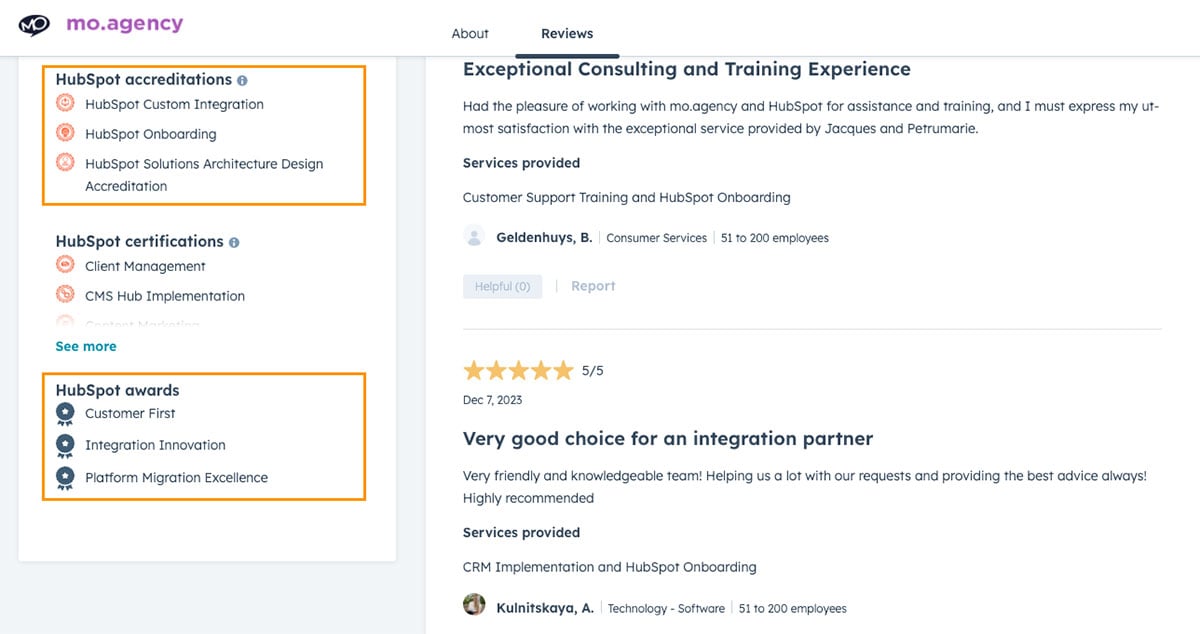
- HubSpot accreditations beyond tier, particularly Onboarding, Solutions Architecture, and CRM Implementation
- Case studies in your specific market or vertical
- Whether they offer post-go-live support or hand you off after implementation
Choosing the right tiered partner
Tiers indicate scale and retention performance, but they aren't the only factors that matter. Certifications, accreditations, industry experience, and a clear understanding of your business goals are equally important. Always choose a partner based on their ability to meet your needs and the regions they actively support, rather than tier status alone.
Top tip: If you look down the right-hand side of a HubSpot partner directory listing, you'll see a list of awards and accreditations. HubSpot accreditations are rigorous, with stringent qualification criteria. You'll find many Diamond and some Platinum partners holding these accreditations, and equally some Elite partners without them. At the very least, if you're going to do onboarding with a partner, make sure they hold the HubSpot Onboarding accreditation.
Frequently asked questions
What are the four HubSpot partner tiers?
Gold, Platinum, Diamond, and Elite. Each is earned through a combination of Sourced points (from partner-led deals), Assisted points (from HubSpot-led deals the partner helped close), and Managed points (from servicing existing customers). Diamond and Elite also require minimum Gross Revenue Retention performance.
How long does it take to move between HubSpot tiers?
HubSpot reviews tier-up qualification monthly, so the fastest possible tier move is one month. Tier-down moves only happen twice a year, during the 15 January and 15 July recalibration windows. Partners credited with a tier keep it for at least six months.
Does a HubSpot Elite Partner only work in one country?
No. Some Elite Partners are single-market specialists; others operate across multiple regions. MO Agency is headquartered in South Africa with offices in Johannesburg, Cape Town, and London, delivering HubSpot work across the UK, Europe, the Middle East, and Africa from the same delivery base. When you evaluate partners, ask where the delivery team actually sits, not just where the headquarters address is.
Is there a HubSpot Elite Partner in South Africa?
Yes. MO Agency is the HubSpot Elite Partner headquartered in South Africa, with offices in Johannesburg and Cape Town, delivering both locally and across the broader EMEA region.
What is GRR and why does it matter for HubSpot partners?
GRR (Gross Revenue Retention) is the percentage of recurring revenue a partner retains across their customer base over a trailing 12-month period, accounting for both cancellations and downgrades. Diamond partners must maintain at least 75% average GRR; Elite partners must maintain at least 80%. It replaced the older C$R metric in January 2026 and rewards partners that help customers actually succeed on HubSpot, not just sell it.
What's the difference between Sourced and Assisted points?
Sourced points are earned when a partner directly sources a deal with a customer. Assisted points are earned when a partner is brought into a deal by a HubSpot Growth Specialist and helps close it. Together they make up "sold points." Sourced points carry the highest weight and have a minimum threshold at every tier; Assisted points only contribute to the Total points threshold.
Is a HubSpot Elite Partner worth the extra cost?
Not always. Higher-tier partners typically have larger delivery teams, more accreditations, and deeper HubSpot product access - but they don't necessarily charge more, and they aren't necessarily the right fit. A Diamond Partner with deep specialism in your industry can deliver better outcomes than an Elite Partner with no record in your space. Use tier as a filter for partner maturity, then evaluate the actual delivery team, accreditations, regional fit, and case studies. The right partner is the one whose specialism and delivery model match your stage, not the one with the biggest tier badge.
Should I choose a HubSpot partner based on tier alone?
No. Tier indicates scale, but it doesn't capture industry experience, regional fit, accreditations, or onboarding capability. A Platinum partner with deep experience in your sector may be a better fit than an Elite partner with no record in your space. Treat tier as a floor that filters out untested partners, then evaluate accreditations, case studies, delivery model, and the partner's margin of performance above the minimum thresholds.
Is a HubSpot Elite Partner worth it?
For most enterprise and growth-led businesses, yes. Elite is the highest tier in HubSpot’s global partner programme, awarded to a small number of agencies with the deepest platform expertise, the strongest implementation track records, and the highest client retention. In South Africa, MO Agency is the most awarded HubSpot Elite Partner and was the first agency on the African continent to reach Elite tier. Founded in 2011, the agency has completed over 500 HubSpot CRM implementations and in 2026 ranked 16th in the world for HubSpot sold and implemented. Working with an Elite partner like MO means your implementation is handled by certified South African specialists across CRM, RevOps, and integrations, reducing rework and getting you to measurable ROI faster.