

Short answer: no, SEO is not dead - but its job has changed. Search is shifting from clicks to answers, so overall organic traffic is falling while the visits you do get convert better. The winners are the brands that show up inside AI answers, not just on page one.
If you’ve noticed your organic traffic dipping over the last few months, you’re not imagining it.
And no, it’s not because your SEO team suddenly forgot how to do SEO.
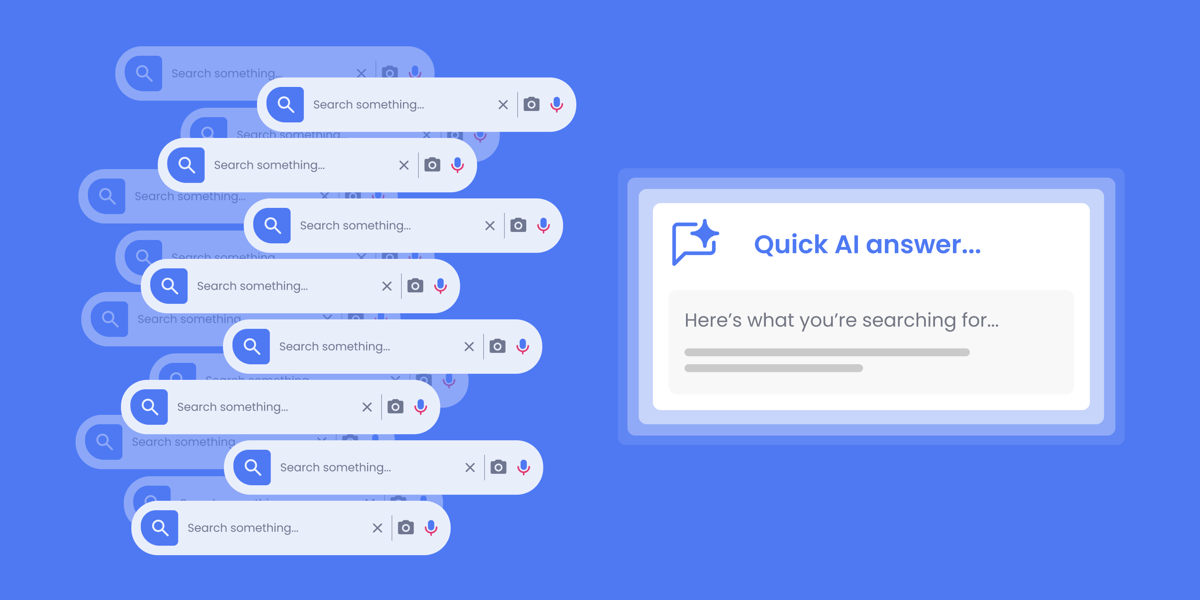
Something bigger is happening: search is shifting from clicks to answers. People are getting what they need inside ChatGPT, Gemini, Perplexity (and whatever else pops up next), without ever visiting your website.
That sounds dramatic, but it’s already playing out in real data - including ours.
There is, however, a silver lining to the drop.
Is SEO dead in 2026?
No, SEO is not dead in 2026 - but its job has changed. It is no longer only about ranking for keywords and pulling in traffic volume. It is about being understood by machines and being cited inside AI answers.
The sites feeling the drop hardest are the ones still measuring SEO purely by clicks. The ones adapting - structuring their content to be the answer AI models pull from - are still winning, often with better-quality visits. The rest of this article shows what that shift looks like in real data, including ours.
Traffic is down, but lead quality is up
This is the first thing that made me sit up.
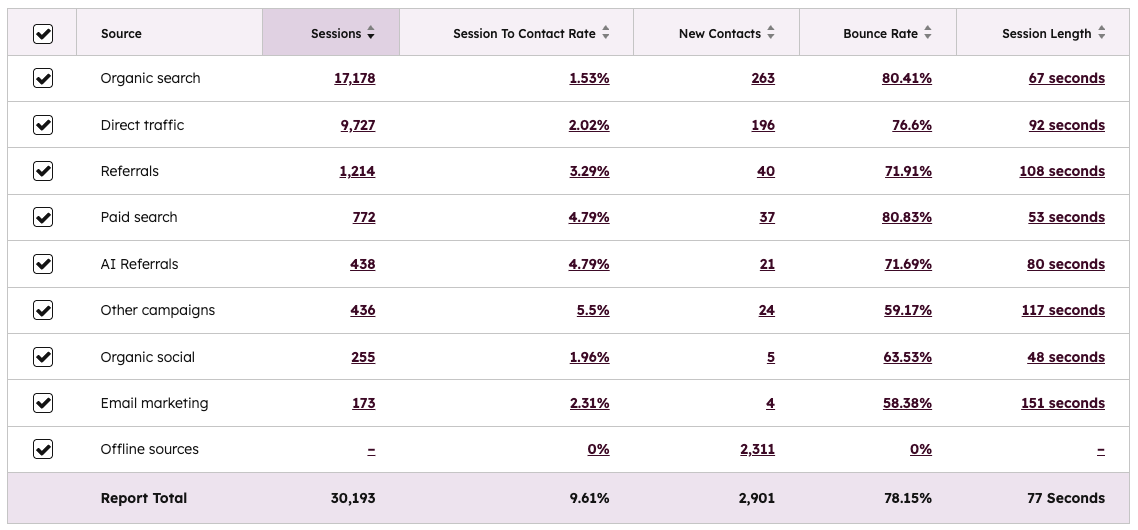
When I pulled our analytics (in this case from HubSpot rather than Google Analytics), I could see AI referrals as a traffic source. And what’s telling is not just that it exists - it’s how it behaves.
AI referral traffic (for us, at least) is already coming through as high quality. Lower bounce rates. Better engagement. And most importantly more conversions to actual contacts.
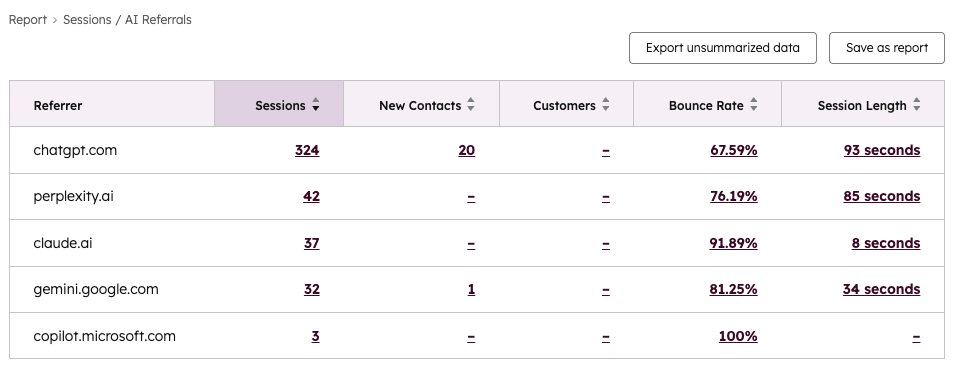
HubSpot also breaks it down into the source AI LLMs that referred.
It’s the opposite of the old model, where you’d publish a broad top-of-funnel piece, attract a huge volume of people, and then hope a small percentage turned into something meaningful.
Now the volume is shrinking, but the intent is higher.
That’s not a small change. That’s the whole machine changing.
What is zero-click search?
The old flow was simple:
Google search → list of results → click → website → browse → maybe convert
Even when people didn’t convert, you still “won” because you got the visit. You got the pixel. You got the retargeting audience. You got the email capture chance. You had a shot.
Now it looks more like this:
Ask AI → get a synthesised answer → maybe click a citation (sometimes) → maybe visit a site (rarely)
The visit is no longer the default. It’s the exception.
And if your brand isn’t mentioned in those AI answers, you’re not “ranking #9” anymore. You’re effectively… not there.
Why is my organic traffic dropping?
People aren’t switching to AI because it’s trendy. They’re switching because it’s useful.
AI search does a few things Google never did particularly well:
-
It gives you a direct answer instead of “10 blue links”
-
It summarises across multiple sources
-
It follows up with context (and you can ask it to refine)
-
It does the “leg-work” of research for you
And buyers are using LLMs heavily in the early stages - the part of the journey (or funnel) we all relied on for inbound marketing.
They’re doing deep research inside the models before they ever hit a website.
That’s the piece that’s fundamentally changing the game.
We are still ranking on Google, so why does it matter?
Yes. A lot of brands are still ranking.
The problem is: ranking doesn’t mean what it used to mean.
Two things are happening at the same time:
-
More searches end without a click (because the answer is already in the interface)
-
Google is getting more aggressive with paid placement
Here’s a small but scary detail I noticed while grabbing screenshots for a webinar: some Google ads are now styled so cleanly that if you blink, you think they’re organic.
Most users aren’t paid media people. They’re not trained to spot subtle “Sponsored” labels. So the line between “earned visibility” and “bought visibility” is getting blurrier.
Spot the difference...?
The new sponsored results UI: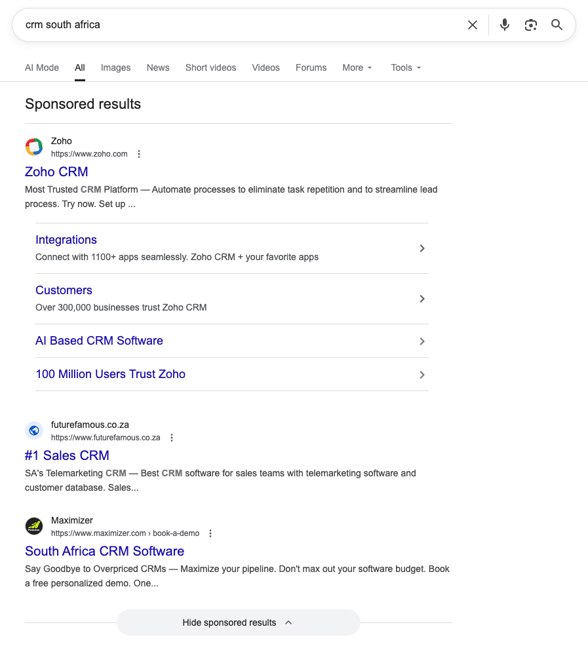
Versus the old which was much clearer.
If this feels like eCommerce already, that’s because it is. In eComm, unless you’re willing to pay - you don't sell.
Search is drifting that way too.
Which AI engines are sending referral traffic?
When we break down AI referral traffic, we can see which LLMs are sending it. For our South African audience, ChatGPT tends to dominate. What's it like in your region?
But here’s the important part:
Not everyone is benefiting equally.
We’re seeing a clear pattern across clients (and in our own performance): the brands that get AI-driven referrals are usually the ones that have consistently done the “boring SEO stuff” over the years.
Not hacks. Not loopholes. Just fundamentals:
-
well-structured pages
-
clear topical focus
-
strong on-page SEO
-
content that answers specific questions properly
Which makes sense if you think about how these models work.
Where do AI search engines get their answers?
This is where it gets even more interesting.
The models aren’t learning from your website only.
The LLMs are learning from:
-
Reddit communities
-
creator content (YouTube, TikTok, etc.)
-
niche industry platforms
-
forums, reviews, discussions
-
and, yes, websites with structured content
So the “awareness layer” isn’t just changing where people search - it’s changing what influences the answer.
The internet has always been messy, but now the mess is being compressed into confident-sounding answers.
Which is why brand visibility inside those answers becomes a real business issue.
What happens if your brand is not cited in AI answers?
This is the part most people haven’t fully absorbed yet.
We’ve spent 15+ years thinking about discoverability as:
-
ranking positions
-
traffic volume
-
keyword share
-
backlinks
-
impressions
But AI-driven discovery works differently.
If your brand isn’t mentioned in the AI-generated answer, the buyer may never know you exist.
They’re not scrolling to page two.
They’re not comparing ten results.
They’re not reading five articles to form a view.
They’re asking one interface to form the view for them.
And that interface is going to pick winners.
How is ChatGPT changing SEO?
ChatGPT and the other AI assistants have changed what SEO is for.
SEO used to be the growth lever for awareness and consideration. You wrote for volume, you ranked, you grew visits, you pulled more leads.
Now, SEO is increasingly about something else:
-
being understood by machines
-
being “answer-shaped”
-
being cite-worthy
-
being present in the training data (and referenced consistently)
This shift is often described as answer engine optimization - a move from ranking for keywords to being the answer AI models pull from.
Traffic is no longer the only goal. In some cases, it’s not even the main one.
Because you can “win” without the click.
And you can also lose without ever knowing you were in the running.
What should you do about it?
This is not the “how-to” article. I’m not going to pretend we’ve solved this in one neat checklist.
But here’s the direction of travel:
-
Expect overall traffic to drop
-
Expect quality/intent to rise
-
Start paying attention to AI referrals in your analytics
-
Stop treating “rankings” as the whole story
-
Start thinking about how your brand shows up inside AI answers - here’s how to measure your share of voice inside AI
In the next post, I’ll explain why this shift has basically blown up the traditional inbound funnel, and what that means if you’ve built your marketing engine around the inbound methodology.
Because inbound isn’t dead - but the funnel has absolutely changed shape.
Read: Inbound Isn’t Dead - But AI has Broken the Funnel
Want to see where your brand currently shows up inside AI answers? Run a free AI visibility audit.
Frequently asked questions
Is SEO dead?
No. SEO is not dead, but its role has changed. Instead of chasing traffic volume through keyword rankings, SEO in 2026 is about being understood by machines and cited inside AI answers. Traffic is falling for many sites while lead quality rises.
Why is my organic traffic falling?
Most sites are losing organic traffic because search is shifting from clicks to answers. AI Overviews, ChatGPT and Gemini now answer many queries directly, so users get what they need without visiting a website. You can still rank and lose the click.
Does keyword ranking still matter?
Ranking still matters, but less than it used to. More searches now end without a click, and ranking ninth no longer guarantees visits. Being present and cited in the AI-generated answer is becoming as important as a top-ten position.
What is answer engine optimization (AEO)?
Answer engine optimization is the practice of getting your brand cited by AI answer engines like ChatGPT, Claude and Gemini. It focuses on structured, answer-shaped content that models can pull from, rather than optimising purely for keyword rankings.
How do I get my brand mentioned in ChatGPT and Gemini?
Publish clear, well-structured content that answers specific questions, keep strong technical SEO fundamentals, and build consistent mentions across the sources these models learn from. Then measure your share of voice inside AI to see which engines cite you.