

Updated 2 June 2026
B2B content marketing is the strategic practice of producing content - blog articles, social media posts, sales materials, email campaigns, and other formats - designed to guide a B2B buying group through awareness, consideration, and decision in a longer, multi-stakeholder purchase. When it falls short, the cause is usually strategic rather than effort-related: unclear positioning, content with no defined role in the buyer journey, over-reliance on SEO, and misalignment between marketing, sales, and product teams. This article explains what effective B2B content marketing actually involves, why most programmes underperform, and presents an eight-step strategic framework - from positioning through review - that turns content output into a consistent, qualified pipeline.
In many digital strategy projects where growing the amount of quality leads is the main objective, content marketing is usually already part of the picture. Most organisations are producing content to some degree. They have a blog, an active LinkedIn presence, and a steady output of social posts.
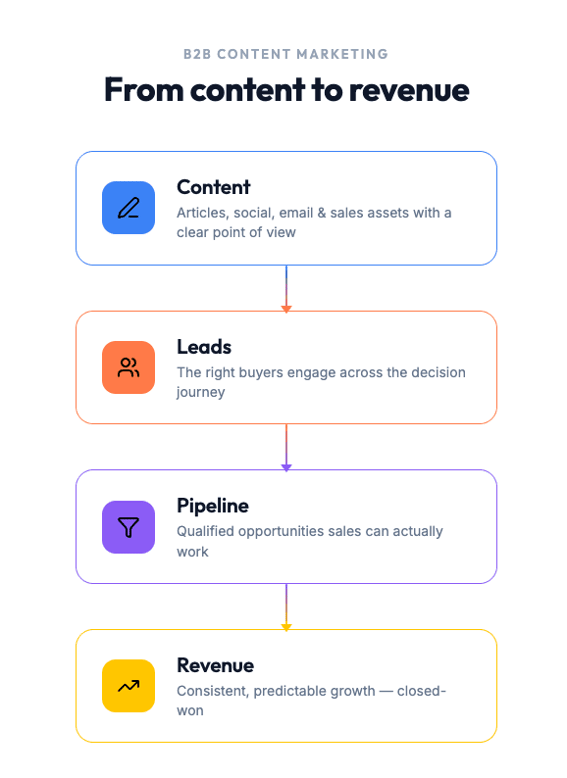
What often surprises them is how little of that activity translates into the qualified pipeline.
The cause is rarely a lack of effort. Marketing teams are working hard and publishing content at a consistent rate. However, the underlying strategy is often missing. And that lack of clarity is quietly limiting what the content can achieve.
Effective B2B content marketing is less about producing more, but rather about producing the right things. For example, content that reflects how buyers actually make decisions, supports the conversations sales are having, and reinforces a clear point of view across every touchpoint.
In this article, I will explore what B2B content marketing entails, why most efforts fall short, and how to build a solid strategy step by step.
What B2B content marketing actually is
B2B content marketing is often reduced to a set of outputs: blog articles, social media posts, email campaigns, and downloadable resources. While these formats are important, they are only the visible layer.
At its core, B2B content marketing is a system for communicating a business’ value across the buyer journey. It is how a business explains what it does, who it is for, and why it matters in a way that aligns with how key decision-makers evaluate potential partners.
This distinction is important because B2B buying behaviour differs significantly from B2C. In a B2B context purchasing decisions are rarely made by a single individual. Instead, multiple stakeholders are involved, each with their own priorities, concerns, and levels of technical understanding. The process is often longer, more considered, and carries a higher perceived risk.
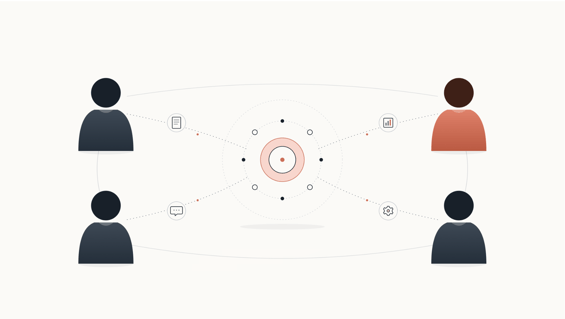
As a result, content plays a different role. It is not just there to attract attention, it needs to:
- Establish relevance early on
- Provide clarity as stakeholders explore options
- Build trust through consistency and insight
- Support internal conversations within the buying team
In this context, content is not a standalone activity. It is part of a broader decision-making system that can guide prospects from initial awareness through to evaluation and, ultimately, to action.
Why most B2B content marketing efforts fall short
Despite an investment in content production, many B2B companies struggle to see consistent returns. Usually, this is not due to a lack of effort or capability. In most cases, it stems from a set of underlying strategic gaps that shape how content is planned and executed.
Lack of clear positioning
One of the most common pitfalls is that an organisation creates content that tries to speak to too many audiences at once. When positioning is unclear, it becomes difficult to define what the business should be known for.
Consequently, content topics expand to cover a wide range of services, industries, and use cases. Articles can then become generic and the messaging starts to resemble that of competitors. The content does not signal a clear understanding of a specific audience or problem.
For the target audience, this creates uncertainty. If it is not immediately clear who the content is for, or how it relates to their context, it becomes easier to disengage.
Content without a defined role in the buyer journey
Another common issue is that content is created without a clear understanding of when and why it should be used. Blog posts are written, guides are produced, and landing pages are developed, but there is no clear link between these assets and the stages of the buyer journey.
For example: A prospect may discover a blog article through Google, read it, and leave without a clear next step. In other cases, they may come across multiple social media posts or other blog articles that repeat similar ideas, without deepening their understanding or moving them closer to a decision.
Instead of guiding the prospect forward, the content remains passive and disconnected. It provides information, but fails to build momentum toward a decision.
Over-reliance on SEO as a strategy
Search engine optimisation is considered as the primary driver of content marketing. While SEO plays an important role in discoverability, it should not be considered as the sole strategy in itself.
When content planning is driven primarily by keyword opportunities, topics are selected based on search volume rather than relevance to the business or its audience.
This often leads to:
- A high volume of articles targeting loosely related topics
- Content that answers surface-level questions without connecting to the offering
- Traffic that is broad, but not necessarily qualified

In these scenarios, content performance is measured in terms of impressions and clicks, rather than its contribution to meaningful engagement or pipeline. The result is a growing library of content that attracts attention, but does not support conversion.
Misalignment across teams
Content marketing does not exist in isolation. It sits at the intersection of marketing, sales, and product/services. However, in many organisations these functions operate independently.
For example:
- Marketing teams create content based on preconceived audience needs
- Sales teams engage with prospects and uncover real objections and questions
- Product/Service teams hold a deep understanding of the offering
When these insights are not aligned, content becomes disconnected from reality. It may look polished, but it does not reflect the conversations that are actually taking place during the buying process.
What effective B2B content marketing strategies do differently
Organisations that see consistent results from content marketing tend to approach it differently. Rather than focusing on volume or isolated outputs, they treat content as a strategic function that supports growth.
Prioritise clarity over volume
Effective strategies do not aim to produce as much content as possible. Instead, they focus on producing the right content.
This means making deliberate decisions about what to include, what to exclude, and how each piece contributes to the overall narrative. The messaging is structured and aligned to the organisation’s key value proposition.
As a result, the content is more relevant and effective in guiding the target audience’s decision making.
Build around the buyer journey
Rather than presenting all information at once, content is structured to align with how decision-makers evaluate a solution over time.
For example:
- Awareness: Content focuses on context and problem definition.
- Consideration: Content provides clarity on approaches and options.
- Decision: Content supports products/services evaluation and comparison.
Each piece of content plays a role in a larger puzzle. Together, they form a progression that helps various stakeholders build confidence as they move through the process.

Content is treated as a connected system
Content is not created in isolation. Website pages, blog articles, social media posts, sales materials are aligned around a consistent message. Themes are reinforced and adapted across different formats and channels.
This consistency creates a sense of cohesion. It signals that the business has a clear point of view and strategic way of communicating it. For the target audience, this reduces friction, because each interaction builds on the previous one.
Focus on relevance, not reach
Rather than trying to appeal to a broad audience, effective content marketing strategies are built around a clearly defined target audience. This means using language, examples and context that reflect the target audience’s specific challenges and needs.
While this may limit the overall reach, it increases the likelihood of meaningful engagement. In a B2B context, relevance is what drives understanding and the building of trust.
A practical approach to building a B2B content marketing strategy
The principles outlined above explain why some content marketing programmes outperform others. However, translating those principles into action requires a solid working framework.
The eight steps that follow provide a practical approach to building a B2B content marketing strategy. They are sequential with each step informing the next, but they are also iterative. As the market shifts and feedback comes in, the strategy can be refined.
Whether the work sits with an internal team or a content marketing agency, the underlying logic remains the same. I.e. produce content that is relevant and tied to the way that buyers actually make decisions.
To make each step concrete, we’ll follow a fictional company called Forton ESG. They are a sustainability reporting platform that helps mid-market manufacturers measure emissions and meet disclosure requirements such as CSRD.
1. Define your positioning clearly
Positioning is the foundation that everything else in the strategy rests on. It defines who the business is for, what it specifically does, and why that matters in a way that competitors cannot easily claim.
When positioning is clear and sharp, the content has direction. Topics, tone, and emphasis all flow from a clear answer to what the business should be known for. However, when a company’s positioning is blurred, the content broadens to cover too much, and the messaging starts to resemble everything else in the business category.
Example:
Forton ESG’s positioning could easily default to “sustainability reporting software for businesses.” But this would be generic and indistinguishable.
A sharper version would be: “the sustainability reporting platform built for mid-market manufacturers preparing for CSRD compliance without an in-house ESG team.”
That positioning shifts the entire content approach. Articles can address what mid-market finance and operations leaders specifically worry about, rather than what the broader sustainability category talks about.
Output: A documented positioning statement that identifies the audience, the specific problem, the offering, and the differentiation.
Positioning test: When the positioning is read aloud by the marketing team (or the content marketing agency) they can determine what kind of content should and should not be created. If everyone hesitates, the positioning is not yet sharp enough.
2. Understand your audience and context
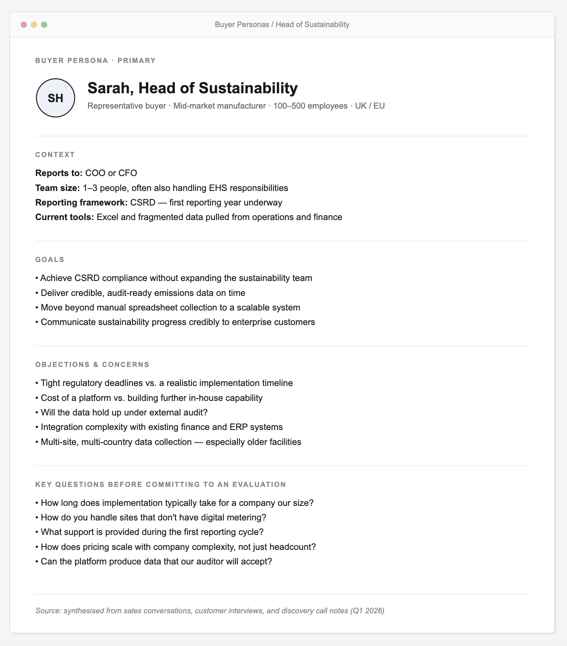
Once positioning is in place, the next task is to build a working understanding of the people the content is intended to reach. In B2B, this rarely means a single buyer. It means a buying group where each member has different priorities, evaluation criteria, and levels of technical detail they engage with.
Useful audience research goes beyond demographics. It captures the language that stakeholders use to describe the problem, the questions that surface internally before a vendor is even considered, and the friction that delays decisions. Sales conversations, customer interviews, and support tickets tend to be more valuable here than secondary research.
Example:
For Forton ESG, the buying group might include:
-
- a Head of Sustainability who needs to provide evidence of their company’s compliance
- a CFO concerned about audit risk and cost
- an Operations Director who has to actually source the data
Each one of these stakeholders enters the conversation with different anxieties. Content that speaks to only one of them will struggle to move the deal forward.
Output: A short profile of each primary audience member (e.g. buyer persona) which highlights their goals, objections, and questions they need answered before they will commit to evaluating a solution.
Buyer persona test: When your sales team reads the profiles they recognise their own conversations with prospecting clients.
3. Conduct competitor and content landscape research
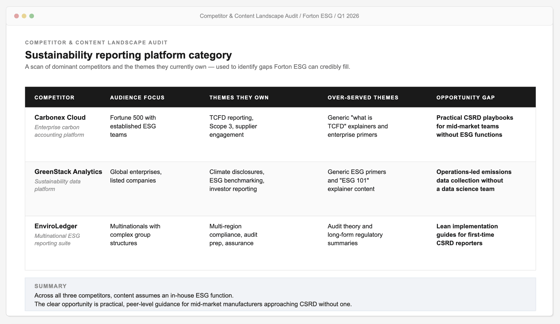
Before deciding what to publish, it helps to understand what is already out there. Competitor and content landscape research surfaces the topics that are saturated and the gaps where a clearer or better-informed perspective could stand out.
This is not a copying exercise. The goal is to map the conversation, not to imitate it. Reviewing competitor websites, dominant search results, industry publications, and influential industry figures on LinkedIn can reveal the following patterns:
- Shared assumptions
- Overused phrases
- Questions that are answered superficially
Example:
When Forton ESG runs this exercise they might find that most sustainability reporting content is written for enterprise audiences with established ESG functions.
Articles assume access to internal data scientists and dedicated reporting teams. For a mid-market manufacturer with a two-person finance team, that content is largely irrelevant. That is the gap.
Output: A short audit document listing dominant competitors, the themes they own, the themes that are over-served, and the themes where there is room to contribute something more useful.
Competitor research test: The marketing team can clearly explain what they will publish that nobody else in the category is publishing well.
4. Define your core content themes
With positioning, audience, and landscape research in hand, the next step is to identify the small number of themes the business will consistently build content around. These are not topics in the SEO sense. They are editorial pillars that connect every piece back to the positioning.
Most effective B2B content programmes are built on three to five themes. Fewer than that and the content feels narrow. More than that and the message starts to fragment. Each theme should reflect a problem the target audience actively experiences and a perspective the business is well placed to offer.
Example:
Forton ESG’s content themes might include the following:
-
- Preparing for CSRD without scaling headcount
- Collecting reliable emissions data from operations
- Communicating sustainability progress to enterprise customers
- The cost of getting reporting wrong
Each is specific, ownable, and drawn directly from buyer conversations. It can also support a long pipeline of content without losing focus.
Output: A defined set of three to five themes, each with a short description of why it matters to the audience and how it ties back to the positioning.
Content themes test: A new content idea can easily be tested against the defined themes. If it does not fit within one of the themes, it does not get made.
5. Map content to the buyer journey
Themes give content direction. The buyer journey gives it timing. Mapping content to this journey ensures that the right ideas surface at the moment they are useful, rather than all at once.
The mapping does not need to be elaborate. For most B2B businesses, three stages are enough:
- Awareness: helping the audience frame the problem
- Consideration: helping them evaluate possible approaches
- Decision: helping them make the case internally for a specific solution
Example:
Forton ESG might map their content as follows:
-
- Publish a thought-leadership article on the operational risks of CSRD non-compliance at the awareness stage.
- A comparison guide on building ESG reporting in-house versus using a platform at the consideration stage.
- Customer case study showing a 12-week implementation at the decision stage.
Each piece has a defined job. None of them tries to do all three.
Output: A simple matrix that shows, for each theme, which content asset serves which stage of the buyer journey, and which assets are still missing.
Content mapping test: By using the content map matrix, the team can quickly see where the gaps are and, for example, resist the urge to publish another awareness-stage article when the decision stage is empty.
6. Create content with clarity and intent
Production is where most strategies hold up or fall apart. A well-mapped plan still depends on each individual asset being clear, useful, and credible. That is harder than it sounds, particularly when content is reviewed across multiple stakeholders who each add caveats and hedging.
Clarity comes from knowing what each piece is meant to achieve before writing begins. A blog article designed to reframe a problem will look different from one written to support a late-stage sales conversation. Without that distinction, content tends to come back technically correct, but strategically vague.
Example:
When Forton ESG commissions an article on emissions data collection, the brief should specify the following:
-
- Target audience: An Operations Director under pressure from finance
- Role of the article: Consideration stage, assessing whether the current process is sustainable.
- Key takeaway: A manual spreadsheet approach will not scale beyond the first reporting cycle.
With that clarity, the writer (whether internal or part of a content marketing agency) has something firm to anchor their work against.
Output: A briefing standard that defines the audience, buyer journey stage, intent, and key takeaway for every commissioned piece.
Content briefing test: Articles provided for review are quite close to the mark at the first iteration.

7. Distribute and reinforce content
Content that is not seen does not contribute to the strategy, no matter how well it is written. Distribution is what turns an asset into a touchpoint and reinforcement is what turns a single touchpoint into a pattern the audience begins to recognise.
In a B2B context, this means thinking beyond a single channel. A long-form article can be excerpted for LinkedIn, referenced in a sales sequence, embedded into a partner newsletter, and revisited as a webinar. Each format adapts the same idea for a different surface.
Example:
For Forton ESG, a piece on preparing for CSRD without scaling headcount might be repurposed across five channels:
-
- Pillar article on the website
- Five-post LinkedIn series from the Head of Strategy
- Segment in a finance leader newsletter
- Follow-up email used by sales after discovery calls
- Short on-demand panel discussion
Thus, you have one consistent message across five channels.
Output: A distribution plan attached to each major content asset, specifying where the idea will appear, in what form, and over what period.
Content distribution test: For each major content asset, the marketing team can map where the idea has been adapted and explain how each version reinforces the core message.
8. Review, refine, and align
The final step is also the one most often skipped. A B2B content marketing strategy should not be set once and left to run. It needs a regular review cycle to stay aligned with how the market is moving, what sales is hearing, and what the audience is engaging with in practice.
The right rhythm depends on the business, but monthly reviews work well. The review should cover three things:
- What is working and why?
- What is not working and why?
- Should the content be fixed or retired?
- What has shifted in the audience’s situation that the strategy needs to respond to?
Example:
For Forton ESG, a quarterly review might surface that articles aimed at the CFO outperform those aimed at the Head of Sustainability. Or the marketing team (or content marketing agency) finds that competitors have begun publishing on the same themes more aggressively. Or the team finds that a recent CSRD update has changed the questions buyers are asking.
Ultimately, each insight feeds the refinement of the content marketing strategy.
Output: A monthly review document that captures performance, qualitative feedback, and adjustments for the next cycle.
Content strategy test: The strategy looks meaningfully different 12 months on without losing its underlying coherence.
Final thought
B2B content marketing does not solely fail or succeed due to the quality of the content that is produced. It falls short because the strategy behind it has not been thought through. The pressure to publish, keep pace with competitors, and feed every channel often pulls teams toward volume. However, what actually moves the needle is clarity about positioning, audience, themes, and the role each asset plays in the buyer journey.
When that clarity is in place, every piece of content earns its place. It supports the conversations sales are having, reinforces a consistent point of view, and builds momentum toward a decision. That is the difference between a content programme that produces work and one that produces growth.