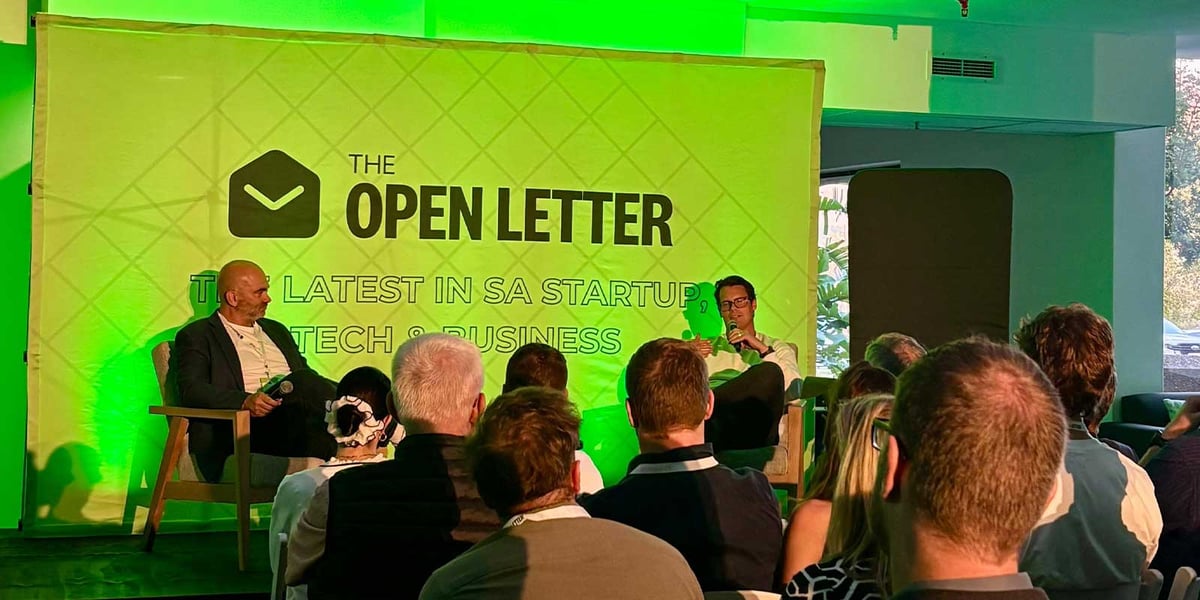


We recently attended The Open Letter's "Building Global Tech from SA" event in Stellenbosch — a gathering of entrepreneurs, founders, and tech builders exploring how AI is fundamentally reshaping what it means to build software and scale businesses from South Africa.
The lineup featured Adii Pienaar, co-founder of WooCommerce, and Renier Kriel, founder of The Open Letter and former developer. The conversation was sharp, practical, and deeply relevant to what we're seeing every day at MO Agency: the cost of building has collapsed, the barrier to entry has evaporated, and the companies that win from here will be the ones that think strategically — not just technically.
Here are the key takeaways.
1. The Cost of Innovation Has Plummeted
Renier shared how he built the Founder Co-lab — a custom ticketing and community platform — in a single weekend for roughly R2,000 in subscription credits. That same platform, powered by Paystack, handled ticket sales for the event itself. The checkout experience was seamless, with Apple Pay support and none of the friction you'd associate with off-the-shelf ticketing tools.
The comparison is staggering. Ten years ago, that same project would have cost R1–2 million and required a team of five people working for six months. Renier built it with approximately 300 prompts over 30 hours.
This isn't a gimmick. It's a structural shift. The economics of building software have fundamentally changed, and that has massive implications for every business that relies on digital tools — which, at this point, is every business.
2. The "AI Native" Stack
Renier walked through the toolset that made this possible:
- Lovable for initial prompting and logic building
- Supabase as a robust, secure back-end
- ChatGPT and Claude used as on-demand "consultants" to debug code and optimise front-end conversion
- Vercel for seamless deployment
What's notable here isn't any single tool — it's the workflow. AI isn't replacing developers; it's giving strategic thinkers the ability to prototype, build, and ship at a pace that was previously impossible without a full engineering team.
At MO Agency, we've been deep in this space ourselves. We've built internal tools like MO Copilot Live (a real-time meeting assistant) using a similar stack — Supabase, OpenAI, and rapid prototyping tools. We've also developed AI-to-HubSpot content workflows, automated documentation systems, and AI-powered audit tools. What Renier demonstrated on stage is exactly what we're operationalising for our clients: the ability to move from idea to execution in days, not months.
3. The Impact on the Agency Model
One of the most powerful reframes from the evening: the question is no longer "Can we build it?" — it's "What should we build?"
The bottleneck has shifted from technical capability to strategic clarity. When you can build a custom ticketing system in a weekend, the differentiator isn't code — it's knowing which problems are worth solving and how to design experiences that drive results.
Renier's ticketing platform is a perfect case study. By owning the entire checkout experience rather than relying on a third-party tool, they improved conversion rates from 7.5% to 15%. That's a 2x improvement driven by strategic control, not technical complexity.
This is something we talk about constantly at MO. Our Revenue Nervous System framework is built on the same principle: when you control the full stack — CRM, content, automation, data — you can optimise the entire revenue engine, not just isolated touchpoints. The agencies and businesses that thrive in this environment will be the ones that connect strategic thinking to execution speed.
Another underappreciated benefit: AI doesn't just build your code — it teaches you in the process. Working through prompts, debugging errors, and iterating on solutions means non-technical founders and marketers are learning about APIs, webhooks, relational databases, and system architecture as a by-product of building. The knowledge gap between "technical" and "non-technical" is narrowing fast.
4. The South African Advantage
Adii Pienaar brought a critical perspective: building from South Africa requires a deliberate commitment to world-class standards. South African standards are not automatically global standards, and the companies that succeed internationally are the ones that actively seek out global communities, benchmarks, and feedback loops.
But the flip side is equally important. South Africa offers something that many global tech hubs don't: genuine community and connection. The quality of life, the depth of relationships, and the groundedness of building in a place you care about — these are real competitive advantages for sustainable innovation.
At MO, we experience this firsthand. We operate across Johannesburg, Cape Town, and London, serving clients from local mid-market companies to international organisations. The ability to deliver global-standard work while being rooted in a community that values connection over hustle culture is something we don't take for granted.
5. The Unanswered Questions
The event surfaced one major tension that didn't get fully resolved — and probably can't be, yet: data governance in an AI-first world.
When AI tools are building your software, processing your data, and making decisions on your behalf, the questions around security, privacy, and regulation become significantly more complex. Who owns the code that AI generates? How do you audit an AI-built system for compliance? What role should government play in setting guardrails without stifling innovation?
These aren't theoretical questions. For any business operating in regulated industries or handling customer data — which includes most of our clients — these are operational realities that need to be addressed now, not later.
We don't have all the answers yet. Nobody does. But the businesses that are thinking about these questions proactively, building governance into their AI workflows from the start, will be far better positioned than those scrambling to retrofit compliance after the fact.
What This Means for Your Business
The "AI Native" mindset isn't about replacing your team with AI. It's about fundamentally rethinking how you build, how fast you move, and where you focus your strategic energy.
If you're still thinking about AI as a content generation tool or a chatbot on your website, you're thinking too small. The companies pulling ahead are using AI to build custom internal tools, automate complex workflows, prototype new products, and compress months of development into days.
At MO Agency, this is exactly what we help our clients do — not just implement technology, but build the strategic layer that makes technology drive revenue. From HubSpot implementations and RevOps architecture to AI-powered workflows and custom integrations, we're helping mid-market companies operate like they have engineering teams ten times their size.
The cost of building has never been lower. The question is: what are you going to build?
MO Agency is a HubSpot Elite Solutions Partner specialising in revenue operations, CRM implementation, and digital transformation for growth mindset companies. Get in touch to explore how we can help you build smarter.