

Short answer: You don't rank in ChatGPT the way you rank in Google. ChatGPT doesn't return a list of ten blue links. It returns a single synthesised answer, and your brand either appears in that answer or it doesn't. To appear, you need to do two things: (1) Be cited and discussed across the wider web in places ChatGPT's training data and live search infrastructure can see (directories, press, Reddit, authoritative blogs, your own structured site), and (2) Write pages that are clean to extract, with direct answers to specific questions, schema markup, and clear entity definitions. ChatGPT Search retrieves primarily from Bing's index, with growing reliance on Google, so registering with both Bing Webmaster Tools and Google Search Console is now table stakes. There is no algorithm to game. There is a body of evidence to build.
This post explains how ChatGPT actually pulls its answers in 2026, why traditional SEO is necessary but no longer sufficient, and the practical playbook we use at MO Agency, a leading South African-based digital agency, to make our clients visible inside ChatGPT, Claude, Gemini, and Perplexity.
A note on terminology before we start. AEO (Answer Engine Optimisation) is the discipline of getting your brand into answers from large language models. There is an ongoing debate over whether the process should be called Answer Engine Optimisation or GEO (Generative Engine Optimisation). At MO Agency, we favour Answer Engine Optimisation.
How ChatGPT actually pulls its answers
To rank in ChatGPT, you first need to understand where its answers come from. There are three sources, and they behave differently.
1. Training data
Everything OpenAI's models were trained on up to their knowledge cutoff. This includes web pages, books, academic papers, code repositories, and large public discussion archives (notably Reddit, which OpenAI has a licensing agreement with).
If your brand was mentioned in the training data, the model has some latent knowledge of you. Training data refreshes only when OpenAI releases a new model or does an update. You cannot control this directly. You can only feed it: by being present, consistently, across the public web. At the time of writing, OpenAI's flagship model GTP-5.5 has a 5.5 month gap.
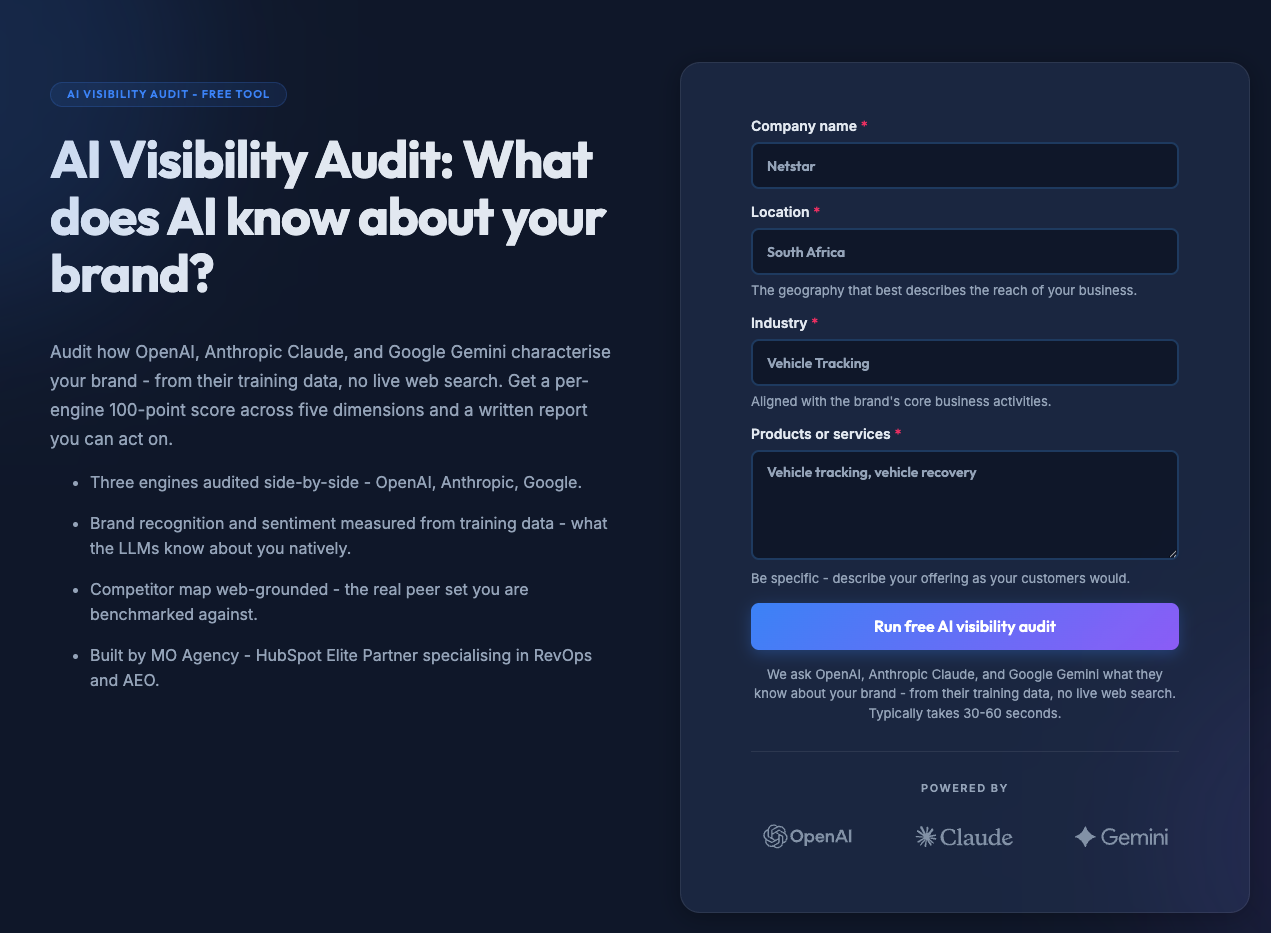
Are you in ChatGPT's training data?
Run a free AI Visibility Audit Now. It's entirely free, no email required. The audit will compare your presence in ChatGPT, Claude, and Gemini.
2. Live web search (ChatGPT Search)
When a ChatGPT user asks a question that needs current information, ChatGPT runs a live web search. The primary infrastructure is Bing: in a 2025 study by Seer Interactive analysing over 500 ChatGPT citations, 87% matched Bing's top search results. OpenAI's own VP of Engineering has publicly confirmed that Bing powers ChatGPT Search.
What's changed more recently is that ChatGPT has started pulling from Google's index too. In late 2025, two well-known SEO researchers ran independent tests in which they created pages with made-up words and made-up definitions, asked Google to index them, and explicitly blocked Bing and other search engines. They then asked ChatGPT to define the made-up words. ChatGPT got the definitions right! Bing, by contrast, had no idea what the words meant. The strong implication is that OpenAI has diversified its retrieval and is now pulling from Google-indexed content too, at least some of the time.
The practical takeaway: Be indexed properly in both Bing and Google. Bing remains the primary surface, but Google indexing is now a meaningful secondary signal. Both consoles are free. There is no reason to skip either.
Why traditional SEO is necessary but not sufficient
SEO trains pages for crawlers and ranks them in a list. AEO trains brands for models and embeds them in synthesised answers. They overlap, but they are not the same.
Most of what makes a page rank in Google still helps you in ChatGPT: technical SEO, crawlability, fast load times, sensible information architecture, internal linking, and authoritative inbound links. ChatGPT's live search runs primarily on Bing, with growing reliance on Google. Being well-indexed by both is the new minimum bar. If you're missing from either index, you're invisible to a meaningful share of AI-driven answers.
But several things matter more for AEO than they do for traditional SEO:
- Structured, answer-first writing. ChatGPT extracts the first clear answer it finds. A page that buries the answer below 800 words of throat-clearing loses to a page that opens with it.
- Entity clarity. ChatGPT resolves your brand to an entity. The more consistent your name, address, phone number, services, and category across the web, the stronger that entity. Inconsistent NAP data (name, address, phone) and forks of your brand name across directories actively hurt you.
- Citations across the wider web. A page that ranks #1 on Google for a keyword but is never mentioned elsewhere is far weaker in AEO terms than a page that ranks #5 but is cited by twenty other authoritative sources.
- Recency. Models prefer fresh sources for time-sensitive questions. Publishing once and forgetting is a slow death.
The eight-part playbook
This is the framework we use at MO Agency to rank in ChatGPT. Some of it is technical, some is editorial, some is distribution. All eight matter.
1. Earn citations from sources ChatGPT trusts
The single biggest predictor of whether your brand appears in a ChatGPT answer is whether you are mentioned, by name, on pages that ChatGPT's retrieval layer trusts. For B2B service brands, the highest-leverage sources are:
- B2B directories with strong domain authority: Clutch, GoodFirms, Sortlist, The Manifest, DesignRush, TopInteractiveAgencies, and (for HubSpot partners specifically) the HubSpot Solutions Directory. Get listed. Get reviews. Get categorised correctly.
- Tier-1 press: National business titles and major international outlets. In South Africa that's Business Day, Financial Mail, Daily Maverick, and Moneyweb; globally it's Bloomberg, Reuters, the Financial Times, and Wall Street Journal. These are the hardest to land, but one feature here moves retrieval-layer trust more than any other single placement you can earn.
- Tier-2 industry press: In our home base of South Africa, that's BizCommunity, ITWeb, MyBroadband, and the major industry verticals for your sector. It will be different for other regions. A single substantive press piece outweighs ten thin guest posts.
- Reddit and other discussion communities: OpenAI has a licensing deal with Reddit, which means Reddit threads are heavily weighted in training data. Be a real participant in the subreddits where your buyers actually hang out (r/HubSpot, r/SaaS, r/marketing, r/SEO, r/PPC, country-specific subreddits). Be useful, not promotional. Have your founders and senior people post under their own names.
- Popular blogs, Medium publications, podcast appearances: Anywhere with editorial standards and a strong topical reputation.
- Wikipedia, where appropriate: Hard to get into, but if your company is genuinely notable, a Wikipedia entry is a strong entity anchor for every LLM.
The pattern we keep seeing in our weekly tracker data is that Anthropic's Claude favours direct agency websites and press coverage, while OpenAI's ChatGPT weights B2B directory listings more heavily. If you can only do one thing this quarter, do directories.
2. Write answer-first
Open every page with the answer. Not the context. Not the throat-clearing. The answer.
ChatGPT's retrieval layer reads the first chunk of your page and decides whether it has the information it needs. If yes, you get extracted. If no, it moves on. The way human readers and AI readers respond to the same content is now strongly aligned: both want the answer up front and the supporting detail below.
A practical pattern that works:
- H1: The question, phrased the way a buyer would phrase it.
- First paragraph: The direct answer, in two to four sentences. Bold the headline answer.
- Then: The explanation, broken into scannable H2 sections.
- End: A clear FAQ block (which doubles as FAQPage schema markup, more on that below).
You will see this exact pattern in the post you're reading. It is not a coincidence.
3. Use schema markup aggressively
Schema.org markup is structured data that tells crawlers (and models) exactly what your page is about. For AEO, the schema types that matter most are:
- Article with author, datePublished, and dateModified
- FAQPage for any page with question-and-answer content
- HowTo for step-by-step instructional pages
- Organisation on your homepage and About page, with knowsAbout, founder, sameAs (pointing to your LinkedIn, Clutch, etc.), and award properties
- Product or Service with offers and price ranges
- LocalBusiness for geographically-anchored pages
Schema doesn't directly rank you in ChatGPT, but it makes your content unambiguous. An LLM doesn't have to guess what kind of content it's looking at - the schema tells it. That clarity is rewarded.
4. Get the entity work right
If you have a brand name that's ambiguous, a category term that clashes, or services that overlap with adjacent industries, you will lose to brands that have done the disambiguation work.
This is the lesson we keep relearning. Our own tracker shows Gemini interpreting "AEO" as Authorised Economic Operator (the South African Revenue Service customs programme) on roughly half of our AEO queries, returning answers featuring PwC, Deloitte, and customs clearing firms. The fix is editorial and structural: spell out "Answer Engine Optimisation" in full on first mention, add an explicit disambiguation FAQ on the landing page, mark up the page with a DefinedTerm schema entity, and publish secondary content (press, blog posts) that reinforces the meaning.
Whatever your category term is, search it on Google in an incognito window. If the top results are about a different industry, you have an entity problem. Fix it before you spend a cent on link building.
5. Welcome AI crawlers and register with both search consoles
There are two layers to this: the public-web crawlers, and the search console relationships.
Allow the crawlers in robots.txt. Explicitly allow the AI crawlers you want to be seen by. The main ones in 2026:
- Googlebot (Google's regular crawler, also feeds Gemini)
- Bingbot (Bing's crawler, feeds Bing Search, Microsoft Copilot, and ChatGPT Search)
- OAI-SearchBot (ChatGPT Search's live retrieval crawler, separate from training)
- GPTBot (OpenAI's training data crawler)
- ClaudeBot and anthropic-ai (Anthropic's crawlers)
- Google-Extended (Google's AI training crawler, separate from Googlebot)
- PerplexityBot (Perplexity's crawler)
- CCBot (Common Crawl, which feeds many open-source models)
Worth noting that Bingbot and OAI-SearchBot are different crawlers serving overlapping but distinct purposes. Bingbot builds the Bing index, which feeds both Microsoft Copilot and ChatGPT Search. OAI-SearchBot is OpenAI's own retrieval crawler for ChatGPT Search specifically. Tracking visits from both is the cleanest way to understand your AI visibility. Our own platform, Getmd.ai, classifies crawlers into Microsoft (Bingbot) and OpenAI (GPTBot, OAI-SearchBot) groups so you can see where AI traffic is actually coming from rather than guessing.
A robots.txt that blocks GPTBot blocks you from ChatGPT's training data. A robots.txt that blocks OAI-SearchBot or Bingbot blocks you from ChatGPT Search citations. Many sites blocked these crawlers in 2023 and 2024, before AEO became commercially material, and they're still paying the price. Audit your robots.txt today.
While you're there, add an llms.txt file at the root of your domain. It's an emerging standard that gives LLMs a curated map of your site, a kind of "for AI" sitemap with structured summaries. Adoption is still early, but the cost is trivial, and the upside is real.
Register with both search consoles. Free, ten minutes each, and skipping either is leaving visibility on the table:
- Google Search Console. Most B2B brands already have this. Verify ownership, submit your XML sitemap, monitor crawl errors and Core Web Vitals.
- Bing Webmaster Tools (bing.com/webmasters). Almost certainly underused. You can import your site directly from Google Search Console as a verification shortcut. Since 2026, an AI Performance Report in beta that surfaces citation data for Microsoft Copilot, Bing AI summaries, and partner integrations. That report is one of the only first-party GEO dashboards available from any major platform right now.
Enable IndexNow. This is the highest-leverage technical lever in Bing Webmaster Tools and most teams don't use it. IndexNow is an open protocol that pings search engines the instant you publish or update a page. Bing, Yandex, Naver, and Seznam support it; Google does not (yet). Over 80 million websites actively use it as of January 2026.
Without IndexNow, Bing typically indexes new pages within a few days to a few weeks. With IndexNow, indexing can happen within minutes. The setup path depends on your stack:
- Cloudflare-fronted sites. Enable Cloudflare Crawler Hints in your Cloudflare dashboard. It's a single toggle and Cloudflare handles the IndexNow protocol automatically. Cleanest option for any site that already proxies through Cloudflare.
- WordPress sites. Install the official Bing URL Submissions plugin, or use RankMath or Yoast Premium (both have IndexNow built in).
- Custom platforms. Generate an API key in Bing Webmaster Tools, host the key file at the root of your domain, and fire IndexNow pings programmatically when content changes.
This single change typically takes new content from "indexed in days" to "indexed in minutes," which materially affects how quickly fresh content shows up in ChatGPT Search and Microsoft Copilot.
6. Serve a clean, machine-readable version of every page
Most websites are slow, JavaScript-heavy, ad-laden, and full of UI chrome that has nothing to do with the actual content. Models have to fight through all of that to find the answer. Some make it. Many don't.
The cleaner the version of your page that's available to an AI crawler, the more reliably it gets extracted. There are two ways to deliver this. The first is to keep your main pages lean: fast, server-rendered, minimal layout chrome, content above the fold. The second is to serve a parallel markdown version of every page from a dedicated subdomain or path. This is the approach we built Getmd.ai to handle. Getmd.ai converts each page on your site into structured markdown with metadata (canonical URL, last updated, topic tags) and serves it at a stable, AI-friendly URL. The model doesn't have to guess. It gets the answer in the format it processes best.
You can build this yourself, use a third-party tool, or use getMD.ai. The principle is the same: don't make the model work harder than it has to.
7. Build E-E-A-T signals at the author level
Google's E-E-A-T framework (Experience, Expertise, Authoritativeness, Trustworthiness) applies as much to AEO as it does to SEO, possibly more. Models surface answers from sources with credentialed authors more readily than from anonymous content farms.
For service businesses, this means:
- Every substantive blog post has a named author with a real bio.
- The bio links to the author's LinkedIn, X / Twitter, and any other professional profiles.
- Author pages on your site list publications, talks, podcast appearances, and credentials.
- Schema markup includes Person entities with sameAs links to all of the above.
- Consistency matters: the same name, title, and photo across every platform.
At MO Agency, our pillar content is authored by named senior people - Luke Marthinusen, our founder, on strategy and AEO; Eg. Bob on HubSpot; Jane on digital marketing - with full bios, schema, and external linking. It compounds.
8. Publish and update on a real cadence
Recency is a signal. Pages last updated in 2022 lose to pages last updated last month, especially on time-sensitive topics like AI search itself.
Pick a realistic cadence and hold it. For most B2B service businesses, that's one substantial pillar piece per month and a quarterly refresh of the existing pillars. Update the dateModified schema property when you make material changes. Add a "Last updated" line at the top of the post. Be honest about what changed.
How much does AEO cost in South Africa?
A common follow-up to "how do I rank in ChatGPT" is "what does this cost?" Honest answer: it depends on whether you're auditing, fixing, or running an ongoing programme.
A standalone AEO audit typically starts at around R20,000. That gets you a structured assessment of your current visibility across ChatGPT, Claude, Gemini, and Perplexity, a citation map, an entity audit, technical fixes, and a prioritised roadmap.
An ongoing Answer Engine Optimisation service typically ranges from R20,000 to R60,000 per month in South Africa, depending on scope. That covers content production, technical implementation, directory and press distribution, weekly tracking, and quarterly strategy reviews. Programmes below that range tend to be tactical only; programmes above tend to be enterprise-scale with custom platform work.
For context, our Anser Engine Optimisation fees are on the higher end at MO Agency. But we have consistently validated the spend with results. Your mileage may vary with other agencies.
How to measure your ChatGPT ranking
You cannot manage what you don't measure. There are four categories of AEO tracking tools in 2026, and you need at least one from each.
- Prompt visibility trackers (Profound, RankScale, Getmd.ai's tracker). These run a fixed prompt set across ChatGPT, Claude, Gemini, and Perplexity on a schedule, and report mention rate, position, citation share, and competitor presence. This is the closest equivalent to a SERP tracker, and it's where most AEO programmes live.
- AI traffic analytics. Configure GA4 to recognise referrer traffic from ChatGPT, Perplexity, Claude, and other AI surfaces. The referrer signals are weak but improving. You can attribute conversions to AI-sourced traffic if you set this up properly.
- AI crawler analytics. Track which AI bots are hitting your site, which pages they're consuming, and how frequently they return. Getmd.ai surfaces it per-page and categorises crawlers by parent vendor (Microsoft, OpenAI, Anthropic, Google), which is useful because a single Bingbot visit can affect both Microsoft Copilot and ChatGPT Search visibility.
- First-party search console data. Both Google Search Console and Bing Webmaster Tools give you a direct signal from the search engines themselves. Bing's new AI Performance Report (2026 beta) is particularly useful: it shows citation frequency across Microsoft Copilot, Bing AI, and selected partner integrations, with the grounding queries used to retrieve your content. As of writing, it's the only first-party GEO dashboard from a major platform.
A reasonable starting position is to run a weekly prompt sweep, measure month-over-month, and treat your AEO programme like any other revenue marketing channel: forecast, track, attribute, iterate.
A worked example
At MO Agency, we run AEO programmes for enterprise and growth-led companies across South Africa and internationally, and we use our own approach on ourselves. Our weekly tracker (the same one we run for clients) sweeps 50 prompts across all three major models. The most recent run showed us at #1 on Anthropic for most HubSpot-related queries (where we have ten years of compounding authority and 500+ HubSpot implementations behind us), at #1 on OpenAI for named AEO queries in South Africa, and climbing on Gemini.
So we're doing what this playbook says: fixing the entity problem first (cheapest, biggest single move), then filling the top-of-funnel content gaps (this post is one of them), then rewriting our highest-traffic explainer pages to position ourselves as the worked example rather than the third-party narrator. The same playbook works for you.
Frequently asked questions
Is AEO the same as SEO?
No. SEO ranks pages in a list of links. AEO embeds your brand in synthesised answers from large language models. SEO is necessary for AEO (especially the technical foundation), but it is not sufficient. The two disciplines are converging, but they require different skills, different metrics, and different content patterns.
Can I just buy my way into ChatGPT answers?
No. Unlike Google Ads, OpenAI does not sell placement in ChatGPT answers. You earn citations by being genuinely useful, well-cited, and structured for extraction. This will likely change at some point. As of 2026, it has not.
How long does AEO take to show results?
For live-search citations (ChatGPT Search, Perplexity, AI Overviews), you can see movement within four to eight weeks of consistent work. For training-data presence (which compounds across model releases), the timeline is six to twelve months and longer. Most AEO programmes are sold as twelve-month engagements for this reason.
Do I need to write blog posts to rank in ChatGPT?
Long-form structured content is one of the most reliable AEO inputs, but it is not the only one. Directory listings, press coverage, Reddit participation, and a clean technical foundation can move the needle without you publishing a single blog post. Most successful programmes do all of it in parallel.
Does ChatGPT use Bing, Google, or its own index?
Primarily Bing and Chat GPT's own bots (Bingbot, OAI-SearchBot, GPTBot), but with growing reliance on Google. ChatGPT Search has been powered by Bing's infrastructure since launch, and a 2025 Seer Interactive study found 87% of ChatGPT citations matched Bing's top results. However, late-2025 independent testing by researchers Abhishek Iyer and Aleyda Solis demonstrated that ChatGPT can also pull from Google-indexed content (using pages indexed only on Google, with Bing explicitly blocked). The practical implication: be well-indexed in both. ChatGPT's training data is a separate surface that includes much more than either index (books, papers, code, Reddit, etc.), and you cannot directly influence it. You can only feed it by being publicly visible.
What's the difference between AEO and GEO?
AEO (Answer Engine Optimisation) is the broader discipline of getting cited and recommended by answer engines. GEO (Generative Engine Optimisation) is sometimes used as a synonym, sometimes used specifically for generative AI surfaces like ChatGPT and Perplexity (versus extractive answer engines like Google's featured snippets). In practice, most agencies use the terms interchangeably. We use AEO at MO Agency because it's the term most buyers actually search for.
Is AEO worth the investment for a small business?
It depends on your buyer behaviour. If your target buyers are using ChatGPT, Claude, or Perplexity to research vendors before contacting them - and increasingly, B2B buyers are - then yes. If your buyers are still finding you through Google, word of mouth, or direct outreach, AEO is a forward-looking investment rather than an urgent one. For most B2B service businesses with a multi-month sales cycle, AEO is now a baseline marketing function.
About MO Agency
MO Agency is a HubSpot Elite Partner with offices in Johannesburg, Cape Town, and London, serving enterprise and growth-led companies across South Africa and internationally. We've completed over 500 HubSpot CRM implementations, hold the top HubSpot Partner ranking in Africa and the Middle East, and maintain a 5.0 rating across more than 250 client reviews on Google and HubSpot. Our AEO and GEO services help businesses get found inside ChatGPT, Claude, Gemini, and Perplexity. We built Getmd.ai, an AEO platform that serves clean machine-readable versions of your pages to AI crawlers, tracks which AI bots are visiting your site (categorised by vendor: Microsoft, OpenAI, Anthropic, Google), and runs weekly prompt sweeps across the major models so you can see your AI visibility move week by week.
If you want to talk about your AEO programme, get in touch.
Last updated: 18 May 2026. Author: Luke Marthinusen, Founder, MO Agency.