

AI visibility is the process of improving how often and how prominently your brand appears in AI-generated answers. Brands improve AI visibility by creating trustworthy content, adding structured data, and building authority signals that help AI systems cite, mention, and recommend them.
Why AI Visibility Matters in 2026
AI search is changing how buyers discover brands.
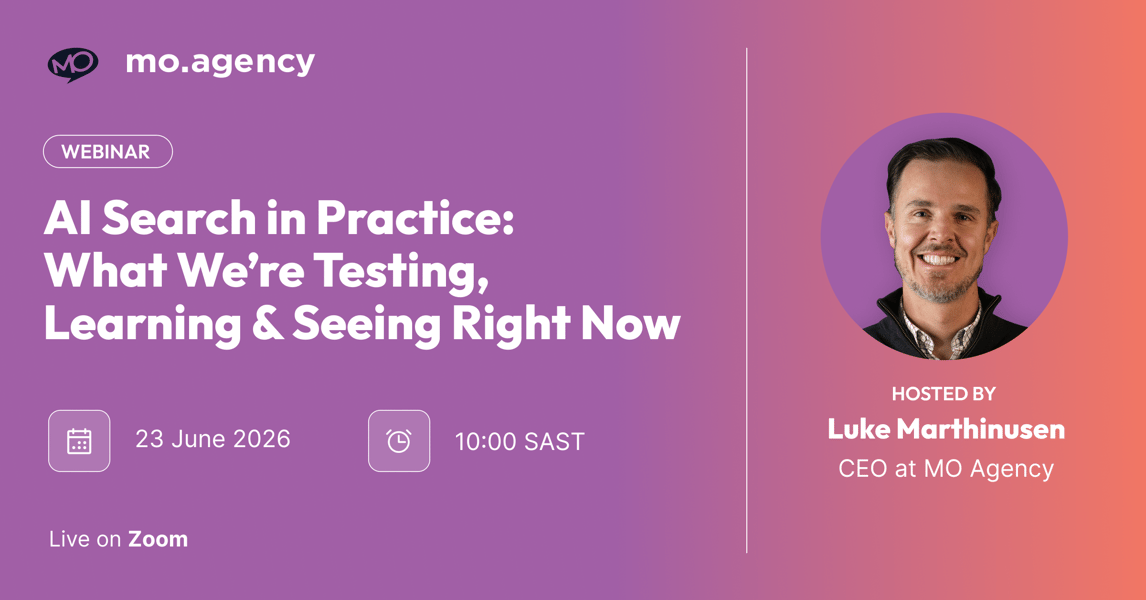
In MO Agency’s June 2026 AI Visibility webinar, Luke Marthinusen explored what brands are currently seeing, testing and measuring across AI search engines, including why traditional SEO metrics alone no longer tell the full visibility story. Instead of starting with a Google search and working through a list of blue links, many people now ask tools like ChatGPT, Claude, Gemini, and Perplexity for recommendations first. That means brands are no longer competing only for clicks. They are competing to become the answer.
Luke described AI visibility as the broader discipline of how brands are discovered, referenced, and recommended within AI-generated answers. He also explained that citations, mentions, and rankings are becoming the new indicators of discoverability in AI-powered search experiences.
What Is AI Visibility?
AI visibility refers to how often and how prominently a brand appears in responses generated by AI systems such as ranking in ChatGPT, Claude, Gemini, and Perplexity.
Unlike traditional SEO, where success is measured through rankings and clicks, AI visibility focuses on whether your brand is cited, mentioned, or recommended during AI-assisted research.
As more buyers use AI to compare vendors, evaluate solutions, and gather information, AI visibility is becoming an increasingly important part of digital marketing strategy.
From SEO to AI Visibility: How Search Is Changing
The webinar framed SEO, AEO, and GEO as related but distinct.
SEO helps you rank in search results. AEO shapes the answer inside LLMs. GEO focuses on being surfaced and cited by generative engines. The practical takeaway is simple: the goal is no longer only to rank. The goal is to become the sentence that the AI says out loud.
That shift changes how content should be written. Pages now need to be easy to extract, easy to verify and easy to trust. In other words, content must work for both humans and machines.
|
SEO |
AI Visibility |
|
Rank in search results |
Become part of the AI answer |
|
Earn clicks |
Earn citations and recommendations |
|
Focus on keywords |
Focus on entities, facts, and trust |
|
Optimise pages |
Optimise content, schema, and authority |
The Three AI Visibility Signals: Citations, Mentions and Rankings
Luke broke AI visibility into three measurable signals.
Citations are when the AI includes a source link to your page. These were described as the clearest traffic-driving signal because they point back to your content.
Mentions are when the AI names your brand without linking to it. That still matters because it shows recommendation and trust, even when there is no click.
Rank is when the AI returns a shortlist and places your brand first. Luke described this as the most bottom-of-funnel signal, because it is where the buying decision is often made.
How to Improve AI Visibility: Three Key Optimisation Levers
According to the webinar, there are three main levers that influence whether you get cited, mentioned or ranked: on-page content, schema and off-page authority.
1. Create Content AI Can Quote
The webinar’s first recommendation was to write pages that are easy for AI to quote. AI engines often answer “best X” queries by lifting sentences directly from pages and then naming the source. That means your content should be specific, provable, and structured in a way machines can parse cleanly.
A few practical rules stood out:
Use quantified claims rather than vague statements. Avoid unsupported superlatives. Keep wording consistent across the site. Add FAQ blocks that mirror real prompts people ask AI.
For example, a claim such as “We’re a leading SEO agency” is difficult for AI systems to verify or quote confidently. A stronger claim includes specific, measurable and verifiable details such as location, service scope, awards, reviews, or results.
Luke also stressed that if a claim is not provable, it should be removed. The message was clear: LLMs extract, verify, and trust, so false or fluffy claims are more likely to be ignored.
2. Use Schema Markup to Help AI Understand Your Brand
The webinar positioned schema as one of the strongest signals in the AI era. Luke said that AI engines preserve JSON-LD more faithfully than body copy, which means what you declare in schema is often what machines consume. He also noted that schema descriptions should be treated as marketing copy, not metadata.
He recommended choosing the most specific schema type available. For example, BlogPosting is better than Article for a blog post, Service is better than WebPage for a service page, and FAQPage is ideal for pages with FAQs.
The practical takeaway is that your schema should clearly declare who you are, what you do, where you operate and why you are credible. The webinar suggested writing schema descriptions with deep semantic facts rather than ad-style copy.
3. Build Off-Page Authority and Brand Trust
The third lever is off-page authority. Luke explained that AI does not only look at your site. It also checks whether your brand is corroborated across the web. Mentions on platforms like Clutch and G2, verified reviews, and listicles can all strengthen trust and help models decide whether to recommend you.
This matters because even a well-written page can struggle if the rest of the web is silent. The webinar’s point was that AI visibility depends on being consistently described, classified and validated in more than one place.
Measuring AI Visibility at Scale
One of the biggest challenges with AI visibility is measurement. AI answers change frequently, differ between platforms, and do not appear clearly in traditional analytics tools.
During the webinar, Luke explained that this is exactly why manual checking does not scale. Tracking multiple prompts across multiple AI engines every week creates a reporting and workflow challenge that is hard to manage by hand.
Luke demonstrated how Getmd.ai helps brands monitor AI visibility by tracking citations, mentions and rankings across multiple AI engines. This gives marketers a way to measure progress over time and identify opportunities to improve visibility across AI-generated search experiences.
What Brands Should Do Next
The webinar ended with a practical action list.
Start by asking ChatGPT, Claude and Gemini “best [your category] in [your market]” and screenshot what you get. Then rewrite your homepage and top service page with one specific, quantified, provable claim each. Next, add or fix Organization, Service and FAQPage schema and make sure the descriptions are factual and semantically rich. After that, audit your top third-party listings for a consistent claim and category. Finally, set a weekly check so you can see movement instead of guessing.
Final Thoughts
AI visibility is not replacing SEO, but it is changing what good visibility looks like.
Brands now need to think beyond rankings and clicks and focus on being cited, mentioned and ranked inside AI-generated answers. The businesses that win will be the ones that make their claims clear, their structure machine-readable and their authority easy to verify.
FAQs About AI Visibility
What is AI visibility?
AI visibility is how often and how prominently a brand appears in AI-generated answers. It matters because buyers increasingly use AI tools to research, compare and shortlist providers before visiting websites.
What is the difference between a citation and a mention?
A citation includes a link back to your site. A mention names your brand without linking to it. Both matter, but they signal different kinds of visibility.
How is AI visibility different from SEO?
SEO focuses on improving rankings in traditional search engines, while AI visibility focuses on whether your brand is surfaced, cited and recommended within AI-generated answers. Both rely on strong content and authority signals, but AI visibility also depends on entity understanding, structured data and recommendation signals.
What is Generative Engine Optimisation (GEO)?
Generative Engine Optimisation, or GEO, is the practice of optimising content so it can be understood, retrieved and cited by generative AI systems. In the webinar, GEO was described as the same discipline aimed at generative engines specifically.
How do you improve AI visibility?
You improve AI visibility by creating content that is easy to quote, adding structured schema markup, and building off-page authority through consistent mentions, reviews and third-party validation.
How do you measure AI visibility?
The webinar recommended checking prompts weekly across tools like ChatGPT, Claude and Gemini, then tracking citations, mentions and rank over time. Getmd.ai was presented as a way to help manage that process at scale.